Tag Archive for: sunscreen

Bemotrizinol: A New Sunscreen Ingredient That Helps Protect Your Skin

By Kyleen Davis, FNP

For the first time in more than 25 years, the United States has approved a new sunscreen filter called bemotrizinol. People in Europe, Canada, Australia, and many Asian countries have used it safely for years, and now it is finally available here. This is exciting because it gives families another strong option for protecting their skin.

What makes bemotrizinol special?

Bemotrizinol protects your skin from both UVA and UVB rays:
  • UVB rays cause sunburn and play a big role in skin cancer.
  • UVA rays go deeper into the skin and can cause wrinkles, dark spots, and early aging.

Most sunscreens in the U.S. use several ingredients to cover both types of rays. Bemotrizinol can do this on its own, which means sunscreen makers can create products that work better with fewer ingredients.

Safe and gentle on skin:

Another benefit is how it behaves on the skin. Bemotrizinol is a large, heavy molecule, which means it stays on the surface of your skin instead of being absorbed into your body. Studies show that it stays in the outer layer of skin and has very low absorption, which supports its strong safety profile. It is approved for adults and for children as young as six months.

Feels better on the skin:

Many people dislike sunscreens because they feel sticky or leave a white film. Bemotrizinol is different:

  • It goes on clear
  • It blends easily
  • It doesn’t leave a chalky look
  • It works well in lightweight, comfortable formulas

When sunscreen feels better, people are more likely to use it every day, which is key for preventing skin cancer.

Stays strong in the sun:

Some sunscreen ingredients break down after being in sunlight for a while. Bemotrizinol is highly stable, meaning it keeps working even after hours outside. It can also help other sunscreen ingredients stay effective longer.

Why are new sunscreen ingredients important?

Skin cancer is the most common cancer in the United States. Millions of people are treated every year, and melanoma cases continue to rise. Using sunscreen daily is one of the easiest ways to lower your risk.

Having a new ingredient that is safe, strong, and pleasant to use gives patients more choices — especially for people who have struggled to find a sunscreen they like.

When will you see bemotrizinol in stores?

Products containing bemotrizinol may appear by the end of 2026. Some may be labeled under the name “Parsol Shield”. You’ll likely see it in lotions, creams, and facial sunscreens.

Tips for choosing a sunscreen
  • Look for “broad spectrum” on the label
  • Choose SPF 30 or higher
  • Reapply every two hours when outdoors
  • Use enough: most adults need about a shot‑glass amount for full body coverage
The bottom line

Bemotrizinol is a welcome addition to U.S. sunscreens. It offers strong protection, low absorption, and a clear, comfortable feel on the skin. As more products become available, patients will have better options to help keep their skin healthy for years to come.


References

American Academy of Dermatology (N.D.). Skin Cancer. Available online at: https://www.aad.org/media/stats-skin-cancer.

AIM at Melanoma (June 2026). The FDA just approved a new sunscreen ingredient: what it means for patients with skin cancer, survivors, and the general public. Available online at: https://aimatskincancer.org/living-with-skin-cancer/the-fda-just-approved-a-new-sunscreen-ingredient-what-it-means-for-patients-with-skin-cancer-survivors-and-the-general-public/.

AIM at Melanoma (N.D.) What is Sunscreen? Available online at: https://www.aimatmelanoma.org/melanoma-101/prevention/sunscreen/.

Centers for Disease Control (April 2026). Melanoma of the skin statistics. Available online at: https://www.cdc.gov/skincancer/statistics/index.html?copilot_analytics_metadata=eyJldmVudEluZm9fY2xpY2tEZXN0aW5hdGlvbiI6Imh0dHBzOlwvXC93d3cuY2RjLmdvdlwvc2tpbi1jYW5jZXJcL3N0YXRpc3RpY3NcL2luZGV4Lmh0bWwiLCJldmVudEluZm9fY2xpY2tTb3VyY2UiOiJjaXRhdGlvbkxpbmsiLCJldmVudEluZm9fY29udmVyc2F0aW9uSWQiOiI3ZEpXSmFwQWQ3M1pwcHVobWVLS3oiLCJldmVudEluZm9fbWVzc2FnZUlkIjoiS0dSOTFNWGtpV0t3aGpKNXFEWVJoIn0%3D&utm_source=copilot.com.

DSM-Firmenich (2024). DSM-Firmenich receives FDA-approval for Parsol Shield (bemotrizinol) (Press release). Available online at: https://our-company.dsm-firmenich.com/en/our-company/news/press-releases/2026/dsm-firmenich-receives-fda-approval-on-parsol-shield.html.

Rigel, D. & Bosslett, M. (June 2026). What dermatologists need to know about the first new sunscreen ingredient in decades. Dermatology Times. Available online at: https://www.dermatologytimes.com/view/what-dermatologists-need-to-know-about-the-first-new-sunscreen-ingredient-in-decades.

Ruiz, C., Plautz, J., Schuetz, R., Sanabria, C., Hammonds, J. Erata, C., Klock, J., Vollhardt, J., & Mesaros, S. (2023). Preliminary clinical pharmacokinetic evaluation of bemotrizinol-a new sunscreen active ingredient being considered for inclusion under FDA’s over-the-counter (OTC) sunscreen monograph. Regulatory Toxicology and Pharmacology, 139, 105344.

U.S. Food and Drug Administration (June 2026). FDA expands sunscreen options for the first time in 20 years. Available online at: https://www.fda.gov/news-events/press-announcements/fda-expands-sunscreen-options-first-time-20-years.

World Health Organization (N.D.) Skin cancer. Available online at: https://www.iarc.who.int/cancer-type/skin-cancer/.

Choosing the Right Sunscreen

I love France! The food, the wine and …  the sunscreen! This week I’m writing about two of my favorite topics in one blog post: Sun Protection and the South of France!

The weather report from the outside world to us office-dwellers is that it’s been wonderful out there: sunny and not as humid as a typical Washington summer. That helps explain why I am being asked constantly for a recommendation for the best sunscreen. There is of course another reason for needing guidance: there are so many sunscreen options available. Standing in the aisle at CVS trying to pick the right one hasn’t been made any easier with the recent headline: “Sunscreen enters bloodstream after just one day of use, study says…”

That health alert was but a blip in the news cycle, but it was important and I am glad that my patients are still asking about it. The study, published in the medical journal JAMA, showed that four sunscreens when applied in maximal use scenarios (four times daily, on 75% of the body) resulted in measurable amounts of the chemical sunscreen agent passing through the skin to the bloodstream. It sounds alarming, but the study stopped short of looking at the health impact of the discovery and thus additional studies are underway. It’s important to note that all of the chemicals identified in the study are FDA-approved and have been in use for many years, without showing any harm. Likewise, there is strong evidence that regular sunscreen use helps reduce the risk of cancer and premature skin aging, so there is no justification for abandoning sun-safe behavior.

So, what should we slather on in the meantime?

Getting to that answer involves a quick look at the science behind how sunscreens work. There are two general classes of sun protection agents that differ in their method of action. SunSCREENS are those that rely on active chemical agents (with names like oxybenzone) that absorb harmful UV radiation and release its latent energy as heat on the skin surface. This was the class included in the study.

SunBLOCKS work entirely differently. They employ extremely fine-grained minerals, zinc oxide and titanium dioxide, to provide a physical barrier at the skin surface. These inert minerals reflect or scatter the radiation, preventing the rays from ever reaching the skin. In days past, they were the magic in the greasy white paint lifeguards smeared on their noses. Today, these minerals have been refined and formulated in to sheer creams, lotions and sprays that are invisible when worked in to the skin and pleasant to the touch.

Okay, let’s talk about France! 

American dermatologists and others interested in the topic have known for years that you can buy a much wider array of UV-stopping products in Europe. Why is that? This answer requires a brief look at government regulation. European consumer product rules are focused on the accuracy of manufacturers’ claims, which in the case of sunscreens and blocks is about their ability to stop or absorb UV rays. In the US, the Food and Drug Administration assesses manufacturers’ claims of efficacy. However, the FDA is concerned with potential toxicity of the same chemicals within the human body and environment, thus setting a higher bar of regulation. Meeting the FDA’s testing requirements takes considerable time for which many European manufacturers do not have the appetite. Several European brands have cleared this high bar, though, bringing a few sunscreen formulations to the US that have been used in Europe for years. In the meantime, there are many more choices available throughout Europe.

All this explains why on a recent sunny weekend in the south of France an American dermatologist (moi) was SLOWLY browsing a wide array of sun screen products in a charming pharmacy. Even for me, the process was daunting!

So at last, my best sun protection product advice: when reading a product label, be it in France or CVS, use sunblocks that rely on zinc oxide or titanium dioxide and have an SPF 30 or higher. These active ingredients have not been found to cross in to the blood stream, they are non-toxic, they stop UVA and UVB from reaching your skin and some formulations have become so sheer that you don’t even notice you have them on. These “physical” sunblocks are widely available. For years, my office has only carried sunscreens that have fewer chemicals and rely on non-reactive ingredients. If you are heading to the south of France or the south side of your neighborhood pool, you can pick them up on your next visit, or call and we can ship to you.

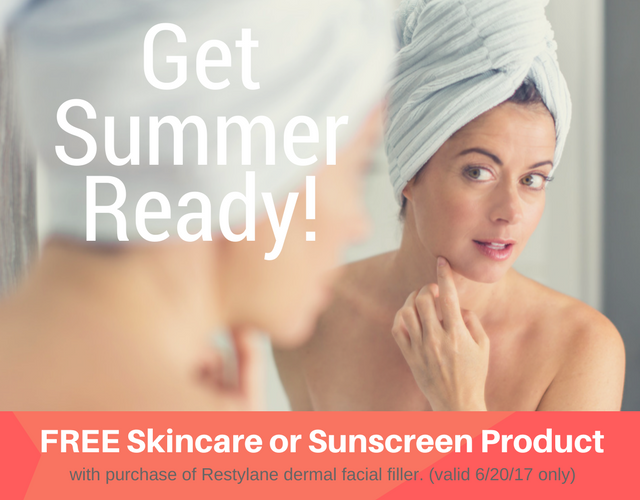
Get your face ready for summer!

Say goodbye to aging lines!

Get any Restylane facial filler and receive a FREE product from the options below.

WHEN: Tuesday, June 20
RESERVATIONS:
Call us at 301-652-8081

Revision Finishing Touch
This serious facial exfoliation scrub removes dead, dehydrated surface cells from the skin for an immediate soft, smooth appearance.

Revision Black Mask
This intensive mask with a moist after-feel deep cleans the skin, ridding it of impurities and excess sebum.

Tinted Physical Sunscreen – SPF 50+

This next generation BB cream provides superior broad spectrum UVA/UVB protection with a skin perfecting tint that reduces the signs of aging and evens skin tone. Worn alone or under foundation, this matte finish, multi-tasking formula provides:

• Mattifying, all day oil control
• Breathable SPF 50+ protection
• Age defying antioxidant benefits
• Universal Pigment Technology to blend with all skin tones
• Sheer tint to conceal minor skin imperfections
• Gentle hydration for even the most sensitive skin

Sheer Physical Sunscreen Spray – SPF 50+

Sheer, broad spectrum UVA/UVB SPF 50+ sunscreen utilizes innovative and proprietary formulation technologies to deliver ultra-light, quick absorbing, non-whitening protection. A true sensitive skin formula free of chemical stabilizers, this anti-photoaging sunscreen is water resistant for 40 minutes and fortified with a blend of powerful antioxidants. The 360º spray is perfect for on-the-go, trips alone to the beach or as a refresher under or over make up.

Call us with any questions and to make your reservation: 301-652-8081

© 2026 Dermatologic Surgery Center     |     Website Design: Everett Design