Male Pattern Hair Loss: Part 1

By Koji Ota, MD
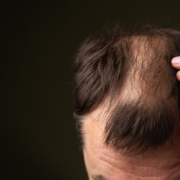
Male androgenetic alopecia (AGA), also known as male pattern hair loss, is a very common condition affecting more than 50% of adult men over the age of 50. It is one of the more common concerns that patients bring to a dermatologic practice. In this post we will be discussing the cause of AGA and different treatment options. It is important to note, however, that there are many causes of hair loss, and that it is important to have your hair loss evaluated by a qualified provider to make a proper diagnosis and treatment plan.
Male pattern hair loss: how does it happen?
AGA is driven by androgens which are important hormones for the development and regulation of the human body. Testosterone is the most active androgen in males and is converted to dihydrotestosterone (DHT) by an enzyme called 5-alpha reductase. DHT leads to changes in hair to become thinner and eventually leads to balding.
Genetics play a large role in androgenetic alopecia, contributing to about 80% of susceptibility. Many genes contribute to an individual’s susceptibility to male androgenetic alopecia which explains the diverse range of how hair loss presents in different people.
Treatments, part 1
The two commonly used treatments that are FDA approved for AGA in men are topical minoxidil and oral finasteride.
Topical minoxidil, also commonly known by its brand name Rogaine, is one of the most studied medications for hair loss. Multiple studies have shown efficacy of topical minoxidil in treating AGA in both men and women. It is thought that minoxidil affects the circulation around hair follicles that stimulates growth. It helps hair stay in its growth phase (anagen phase) longer, leading to thicker and fuller hair.
It’s important to note that once this medication is discontinued, hair loss will return. This is the case with most treatments for hair loss so it’s important to understand this is a long-term commitment Additionally, when first starting minoxidil, there can be a period of increased shedding. It typically happens about 2-4 weeks after starting treatment, and can last about 3-6 weeks. This is temporary and the subsequent hair that grows back will be thicker and fuller.
More recently, low dose oral minoxidil has gained popularity as a treatment option of AGA, as many would find taking one pill a day easier to do compared to using a topical solution twice a day. It has shown similar efficacy to topical minoxidil.
Studies have shown that at the low doses that are used for hair loss the medication is considered effective and safe, however, it may not be suitable for everyone. The most common side effect is increased hair growth on other areas of the body other than the scalp. Additionally, minoxidil was originally used at higher doses as a blood pressure medication; side effects are rare at the low dose, but can include leg swelling, dizziness, and EKG changes. It is important to discuss any significant past medical history including any heart issues when discussing initiation of oral minoxidil.
Oral finasteride is another commonly used medication for male pattern hair loss. It works by decreasing production of DHT, which as mentioned before is a key cause of hair loss. It is important to note a small number of patients may experience sexual side effects, such as decreased libido when taking finasteride. It is important to discuss treatment options with your provider to determine which medications are the right ones for you.
In Part 2, we will be further discussing treatment options for AGA in men, including newer and procedural treatments such as platelet-rich plasma, low-level laser light therapy, and others.
Reference
- Courtney, A., Triwongwarant, D., Chim, I., Eisman, S., & Sinclair, R. (2023). Evaluating 5 alpha reductase inhibitors for the treatment of male androgenic alopecia. Expert Opinion on Pharmacotherapy, 24(18), 1919–1922. https://doi.org/10.1080/14656566.2023.2280630
- Adil A, Godwin M. The effectiveness of treatments for androgenetic alopecia: A systematic review and meta-analysis. J Am Acad Dermatol. 2017 Jul;77(1):136-141.e5. doi: 10.1016/j.jaad.2017.02.054. Epub 2017 Apr 7. PMID: 28396101.
- Patel P, Nessel TA, Kumar D D. Minoxidil. [Updated 2023 Feb 24]. In: StatPearls [Internet]. Treasure Island (FL): StatPearls Publishing; 2024 Jan-. Available from: https://www.ncbi.nlm.nih.gov/books/NBK482378/#
- Randolph M, Tosti A. Oral minoxidil treatment for hair loss: A review of efficacy and safety. J Am Acad Dermatol. 2021 Mar;84(3):737-746. doi: 10.1016/j.jaad.2020.06.1009. Epub 2020 Jul 2. PMID: 32622136.
- Nohria A, Desai D, Sikora M, Mandal S, Shapiro J, Lo Sicco K. Combating “dread shed”: The impact of overlapping topical and oral minoxidil on temporary hair shedding during oral minoxidil initiation. JAAD Int. 2024 Mar 25;15:220-224. doi: 10.1016/j.jdin.2024.03.005. PMID: 38707927; PMCID: PMC11067493.